Fun Facts About Yarm, North Yorkshire: The Story Behind the Famous Yarm Viaduct
There are towns that you pass through without much thought, and then there are places like Yarm—the kind of town that quietly surprises you the moment you start paying attention.
At first glance, Yarm feels like a traditional English market town with a tidy High Street, stone buildings, and a slow rhythm of daily life. But look a little further, especially toward the edge of the skyline, and one structure immediately changes the scene: the Yarm Viaduct. It rises above everything else, cutting across the landscape in a way that feels both dramatic and permanent, as if it has always belonged there.
The story of this structure, the Yarm Viaduct, is really the story of how Yarm stepped into the modern world.
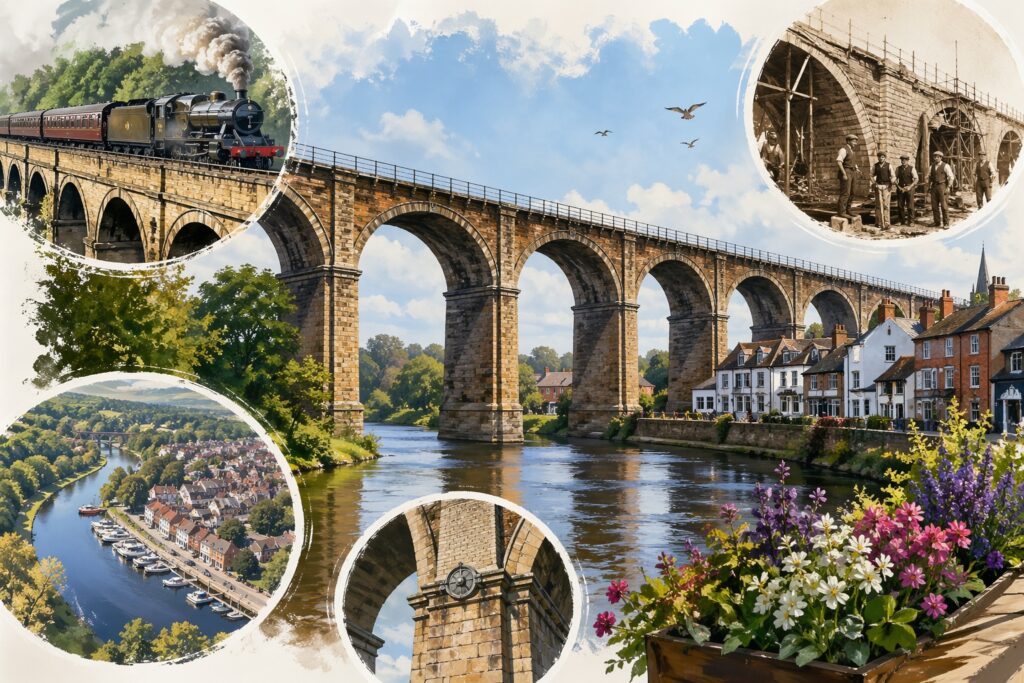
A Landmark That Defines the Town
It is hard to talk about Yarm without mentioning the viaduct. Locals see it every day, whether they are walking along the river or standing in the town centre. Visitors often notice it even before they realise what it is.
Stretching across the valley of the River Tees, the viaduct is made up of long rows of stone arches that seem to repeat endlessly across the landscape. It has a calm symmetry to it, but also a kind of quiet power. Even after more than a century and a half, it still feels bold.
What makes it even more interesting is that it is not a relic frozen in time. Trains still pass over it daily, just as they did when it was first opened.
Born From the Age of Railways
To understand why the viaduct exists, you have to go back to a period of huge change in Britain. The 19th century was the age of railways, when tracks were being laid across the country at an astonishing pace.
Yarm became part of that transformation through its connection to the Stockton and Darlington Railway, one of the most important early railway systems in the world.
Railways were not just about travel. They were about opportunity. Towns that once relied on river trade and local markets suddenly found themselves linked to cities, ports, and industrial centres far beyond their borders. Yarm was one of those towns that changed with the times rather than being left behind by them.
Engineering That Still Holds Up Today
One of the most impressive things about the viaduct is not just its appearance, but how it was built. Victorian engineers worked with limited machinery compared to what we have today, yet they created structures that have lasted for generations.
The viaduct’s stone arches were carefully designed to spread weight evenly across the structure. This allowed heavy steam locomotives of the time to pass safely over the valley below. There is something almost timeless about the way it was constructed—practical, but also elegant in its own way.
Even now, standing beneath it and looking up, it is easy to appreciate the scale of the work involved. It feels solid in a way that modern structures sometimes do not.
More Than Just a Railway Bridge
Over time, the viaduct has become more than a functional piece of infrastructure. It has turned into part of Yarm’s identity.
For many people living in North Yorkshire, it is one of those landmarks that quietly anchors a place in memory. You might not think about it every day, but it is always there in the background.
Photographers often capture it at different times of day, especially when the light hits the arches at an angle. From certain viewpoints, it almost looks like a painting—structured, calm, and slightly dramatic at the same time.
Everyday Life Beneath a Giant Structure
What makes Yarm unique is how normal life continues right beneath such an impressive structure. People shop, walk, cycle, and go about their routines while trains pass overhead without much disruption.
That contrast is part of the charm. You have centuries-old market town life happening beneath a Victorian engineering project that still serves modern transport needs.
It is not something that feels staged or designed for tourism. It is simply how the town functions.
A Town Shaped by Movement and Trade
Before the railway arrived, Yarm was already a market town with a long history of trade. Its position near the River Tees made it a natural point for exchange and travel.
But the arrival of the railway changed its scale. Goods moved faster, connections widened, and the town became part of a larger economic system. The viaduct was not just a bridge—it was a link between Yarm and a rapidly modernising country.
Why the Viaduct Still Matters Today
Some old structures fade into the background of modern life, but the Yarm Viaduct has not done that. It still feels relevant because it is still in use. That continuity is rare.
It connects past and present in a very direct way. Every train that crosses it is a reminder that history is not something separate from everyday life—it is still happening, just at a different speed.
Final Thoughts
Yarm may not be large, but it carries a surprising amount of history within it. The viaduct is the most visible part of that story, but it is also a symbol of something bigger: change, adaptation, and continuity.
In Yarm, the past is not locked away in museums. It is built into the landscape itself. And the Yarm Viaduct is the clearest example of that—a structure that still does its job while quietly shaping the identity of the town around it.
The written content on this page was generated by ChatGPT.