How Yarm’s Population and Housing Have Changed Over Time
Yarm, a historic market town on the River Tees, has changed considerably over the centuries. Once known for its importance as a trading centre and river crossing, it has gradually developed into a residential community where historic buildings sit alongside newer homes and modern amenities. Its growth reflects changes in employment, transport, family life, and the demand for housing across the wider Teesside area.
Understanding how Yarm’s population and housing have changed over time offers an interesting look at the town’s development. From its historic centre and traditional streets to the suburban neighbourhoods that expanded during the twentieth century, Yarm’s built environment tells a story of a community adapting to changing needs while retaining much of its distinctive character.
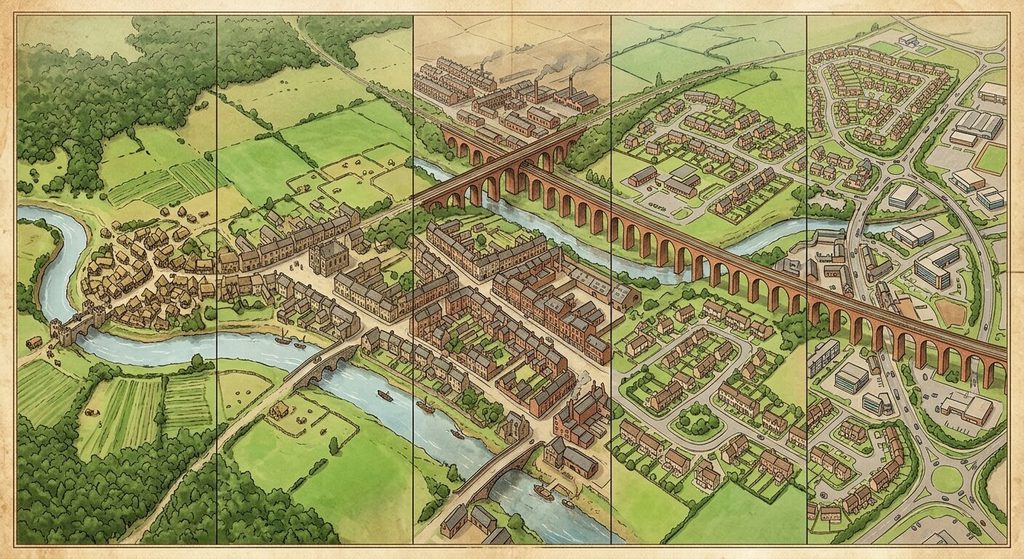
Yarm’s Early Growth as a Market Town
Yarm’s location played an important role in its early development. Situated beside a bend in the River Tees, the town grew around a natural crossing point that helped connect communities on either side of the river. Its position supported movement, trade, and communication, making it an important settlement in the surrounding area.
During the medieval period, Yarm developed as a market town where merchants, farmers, and local residents could exchange goods. The river and nearby routes helped bring people into the settlement, while commercial activity supported the growth of shops, businesses, and homes.
Housing during this period was closely connected to the town’s economic life. Rather than being separated into distinct residential and commercial districts, homes and workplaces often occupied the same buildings or stood close together. Properties near the main street were particularly useful for people involved in trading, crafts, and other local occupations.
As Yarm developed, its historic centre became an important part of its identity. The layout of the town, its older buildings, and its relationship with the river all reflect the practical reasons people chose to settle there.
Traditional Housing and the Historic Town Centre
For much of Yarm’s history, housing developed gradually rather than through large-scale residential projects. Buildings were constructed, altered, extended, and replaced as families and businesses needed more space or different facilities.
Yarm High Street became a central feature of the town’s built environment. Its historic streetscape includes buildings associated with the area’s commercial past, giving the town a character that differs from more recently planned residential areas.
Traditional properties often served several purposes. A building might contain a shop on the ground floor and living accommodation above, allowing traders to work close to their homes. Other properties provided space for families, craftspeople, and workers who relied on the local economy.
Over time, these buildings underwent changes in ownership and use. Some premises continued to serve commercial purposes, while others were adapted to meet modern residential or business requirements. Such changes demonstrate how historic buildings can remain useful even as the surrounding community evolves.
The continued presence of older properties also highlights an important aspect of housing in Yarm: growth has not simply meant replacing the past with the new. In many parts of the town, historic buildings remain part of everyday life.
How Transport Changed Residential Development
Transport has been one of the major influences on Yarm’s growth. The River Tees originally helped the settlement develop as a crossing point, but improvements in road and railway connections eventually changed how residents travelled and worked.
The railway viaduct, completed in the nineteenth century, became a prominent feature of the local landscape. Improved rail connections formed part of a wider transformation in travel across the region, making movement between towns increasingly practical.
As transport networks developed, residents gained more opportunities to travel beyond their immediate neighbourhoods. Work, education, shopping, and other daily activities no longer had to be concentrated entirely within the town.
These changes helped alter the relationship between home and employment. Whereas earlier generations often lived close to their workplaces, later residents could increasingly consider living in Yarm while travelling elsewhere for work.
Better road access also contributed to this shift. As private car ownership became more common during the twentieth century, residential locations outside major industrial and commercial centres became more practical for commuters.
For Yarm, this changing relationship with transport helped create the conditions for residential expansion beyond its traditional centre.
Twentieth-Century Housing Expansion
One of the most significant changes in Yarm’s physical development occurred during the twentieth century, when housing began spreading beyond the historic settlement.
Stockton-on-Tees Borough Council’s conservation and historic environment documentation describes how the original town occupied a relatively contained area within a bend of the river. Substantial suburban expansion during the twentieth century extended development beyond this historic setting.
This change reflected wider trends across England. Population growth, rising expectations for domestic comfort, improved transport, and changing household needs all increased demand for different types of housing.
Newer residential areas offered opportunities to build homes with layouts and facilities that were difficult to accommodate in older properties. Detached and semi-detached houses, gardens, driveways, and more spacious interiors became attractive features for many households.
These developments also changed the physical relationship between Yarm’s centre and its residential neighbourhoods. The town became more than a compact market settlement, with a broader built-up area supporting a growing range of households.
The expansion did not erase the historic centre. Instead, older streets and newer residential districts developed alongside one another, creating a town with different architectural styles and periods of construction.
Population Change in Yarm: What the Census Reveals
Population figures help explain how Yarm has evolved, although it is important to distinguish the town or parish from the wider Stockton-on-Tees local authority area.
According to the 2021 Census figures presented for Yarm Parish, the parish had a population of 8,633 people across an area of approximately 497 hectares. The same source reports a mean age of 42.7 years. These figures provide a useful snapshot of the community at the time of the census. <Cite refs={[“turn925037search5″,”turn925037search7”]}/>
Population change is influenced by several factors, including births, deaths, migration, household size, and the availability of housing. When a town attracts new residents, demand can increase for homes, schools, shops, healthcare, and transport services. Changes in household size can also affect housing demand, even when population growth is relatively modest.
For example, a growing number of smaller households may create demand for different types of accommodation than a population dominated by larger families. Older residents may also have different housing requirements from younger people purchasing their first homes.
These factors help explain why population figures alone do not tell the whole story. To understand Yarm’s development, it is necessary to consider how the number, type, and occupancy of homes have changed alongside the population.
The Changing Types of Homes in Yarm
Yarm’s housing stock reflects different periods of development. Older properties around the historic centre sit alongside homes built during more recent phases of suburban growth.
Traditional houses remain an important part of the town’s architectural character. Some feature historic details and layouts that reflect earlier building practices, while others have been modernised to provide contemporary kitchens, bathrooms, heating, and insulation.
Newer residential areas generally offer a different style of housing. These developments may include detached and semi-detached homes, terraced properties, and other layouts designed around modern household needs.
The differences are not simply visual. The age and design of a property can influence maintenance requirements, energy efficiency, room layouts, parking availability, and the amount of outdoor space.
For prospective buyers, this creates a range of considerations. Someone interested in an older property may value its character and central location, while another household may prefer a more recently built home with modern facilities and a different floor plan.
Yarm’s mixture of older and newer housing therefore contributes to its appeal to people with different preferences and budgets.
Housing Demand and the Appeal of Living in Yarm
Yarm’s residential appeal is closely linked to its historic setting, local amenities, and connections with the wider region.
The town offers a distinctive combination of a traditional market-town centre and established residential neighbourhoods. Its High Street provides access to shops, pubs, restaurants, and other businesses, while the surrounding area offers access to the River Tees and nearby countryside.
For some households, these features make Yarm attractive as a place to settle rather than simply a destination to visit. The availability of local services and connections to employment centres can also influence where people choose to live.
However, demand for housing does not affect every property in the same way. Location, property condition, size, energy efficiency, parking, and access to amenities all influence a home’s suitability for a particular buyer.
Housing affordability is another important consideration. Changes in mortgage costs, household incomes, rents, and property prices can affect whether younger residents can buy locally or need to consider other areas.
It is therefore useful to view Yarm’s housing market within its wider regional context. The town is part of the Stockton-on-Tees borough, which contains settlements with different housing markets, population characteristics, and levels of demand. The Office for National Statistics’ Stockton-on-Tees local statistics provides a starting point for exploring these broader patterns. <Cite refs={[“turn925037search1″,”turn925037search4”]}/>
Preserving Historic Homes While Accommodating Growth
One of the challenges facing a historic town is finding a balance between protecting its architectural character and meeting contemporary housing needs.
Older buildings can require specialist repairs, careful maintenance, and improvements that respect their original features. Owners may need to consider traditional materials, historic windows, roof structures, and other details when planning renovations.
At the same time, homes must remain practical for modern life. Residents may want improved insulation, efficient heating systems, better accessibility, and updated internal layouts.
In Yarm’s historic areas, these priorities need to be considered alongside the character of the surrounding streets. Stockton-on-Tees Borough Council’s conservation and historic environment guidance provides relevant background on the importance of Yarm’s historic setting and the way twentieth-century suburban growth changed the original settlement. <Cite refs={[“turn925037search23”]}/>
New housing presents a different set of considerations. Residential development can provide homes for new households, but it also needs to be considered in relation to roads, drainage, public spaces, local services, and the surrounding landscape.
The aim is not to prevent a town from changing. Rather, it is to ensure that new development and improvements to existing homes contribute positively to the community while respecting the features that make Yarm distinctive.
What the Future May Hold for Yarm’s Population and Housing
Yarm’s future development will depend on several interconnected factors. Population trends, household formation, housing affordability, planning decisions, and regional employment opportunities are all likely to influence demand.
The need for suitable homes may also change as the population ages and household preferences evolve. Some residents may look for smaller, more manageable properties, while families may prioritise additional bedrooms, gardens, and access to schools.
Energy efficiency is another issue likely to influence housing decisions. Improving insulation, reducing energy consumption, and updating heating systems can help make older homes more comfortable and affordable to run. New developments will also need to respond to changing expectations around sustainability.
Future construction and renovation will be shaped by planning policies and the availability of suitable land. In a town with a historic centre and a distinctive riverside setting, decisions about where and how development takes place will remain particularly important.
Rather than assuming that Yarm will continue to grow at a particular rate, it is more useful to monitor census results, local planning applications, housing completions, and property-market data. These sources can show whether changes in population are being matched by changes in the housing supply.
Yarm’s population and housing have changed alongside its development from a historic market town into a broader residential community. Its early growth was closely linked to trade and the River Tees, while improvements in transport and twentieth-century suburban expansion helped reshape where people lived.
Today, the town’s housing reflects this long process of change. Historic properties preserve connections with earlier generations, while newer residential areas accommodate different household needs and modern lifestyles.
Understanding these changes requires more than looking at population totals or counting newly built homes. It means considering the relationship between residents, housing choices, transport, local services, and the historic environment.
As Yarm continues to evolve, maintaining that balance will be important in ensuring that the town remains a practical place to live while preserving the character that distinguishes it from other communities across the Tees Valley.
The written content on this page was generated by ChatGPT.