A Walk Through Yarm England’s Georgian High Street and Historic Core
There are towns that you pass through quickly, and then there are places like Yarm, where you naturally slow down without meaning to. Something about the layout of the streets, the proportions of the buildings, and the quiet confidence of its history encourages you to take your time. Yarm in North Yorkshire is one of those rare places where the past is not staged or recreated. It simply exists in plain sight, woven into daily life.
The Georgian High Street is the clearest expression of that character. Long, wide, and lined with elegant brick buildings, it stretches through the town like a reminder of how important Yarm once was as a trading centre along the River Tees. Yet despite its historical weight, the street never feels like a museum. It feels lived in.
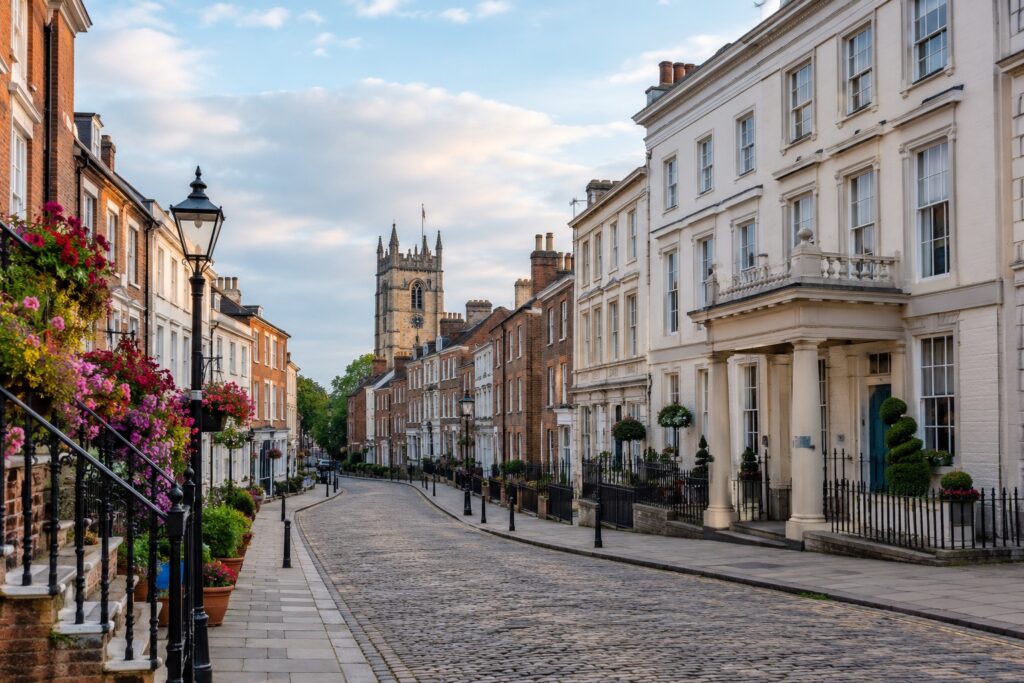
Arriving in Yarm and the First Impression of Space
One of the first things people notice when they arrive in Yarm is the width of the High Street. It is unusually broad for an English market town, and that alone hints at its past purpose. This space was not designed for modern traffic or aesthetics. It was created for markets, livestock, and the steady movement of traders who once filled the town with noise and activity.
Standing at one end of the street, you can see how it gently curves, rather than running in a rigid straight line. That subtle bend gives the town a softness, as if it grew naturally rather than being imposed by planners. It also means that views shift constantly as you walk, revealing new angles of architecture and detail with every few steps.
Georgian Architecture That Still Shapes the Town
The Georgian period left a strong visual identity in Yarm, and it remains the dominant architectural influence today. Rows of red brick and pale stone buildings line both sides of the High Street, many of them dating back to the 18th and early 19th centuries. Their uniform height and carefully balanced windows create a sense of order that is immediately recognisable.
What makes the architecture particularly interesting is not just its preservation, but its continuity of use. Many of these buildings still serve their original purpose in a modern form. Where there were once merchant houses or storage spaces, there are now independent shops, cafes, and offices. The structure has adapted without losing its character.
Look closely and you will notice subtle differences between buildings. Some facades are slightly more ornate, with decorative door surrounds or carved stone details, while others are simpler and more functional. These variations reflect the different phases of development during Yarm’s growth as a market town.
A Market Town Built on Trade and Movement
Yarm’s history is closely tied to commerce. Long before it became a picturesque Georgian destination, it was a working market town serving the surrounding rural area. The High Street was designed to accommodate large gatherings of people and animals, which explains its unusual scale.
Cattle markets once dominated this space, with livestock being driven directly through the centre of town. Traders would gather here on designated market days, turning the street into a lively hub of negotiation and exchange. That energy shaped the identity of Yarm for centuries and still echoes faintly in the layout today.
Even though the markets are no longer held in the same way, the commercial spirit remains. Independent businesses continue to thrive, and the High Street still functions as the town’s economic and social centre.
Walking the High Street Today
Walking through Yarm now, the experience is far more relaxed than it would have been in centuries past. Instead of livestock and traders, you find people moving between cafes, boutiques, and local shops. There is a steady rhythm to the place, never rushed, never completely still.
Cafes spill softly onto the pavement when the weather allows, and conversations drift out into the street. Small details catch the eye as you walk: painted signage, flower boxes, old brickwork softened by time, and narrow alleyways leading just off the main route.
It is easy to imagine how the street would have looked in earlier centuries, yet the modern version has its own appeal. It feels balanced between preservation and everyday use, which is part of what makes it so distinctive.
Layers of History Beneath the Surface
Although the Georgian era defines Yarm visually, the town’s history stretches further back. Its position near the River Tees made it an important crossing point long before the elegant architecture arrived. Movement and trade have always been central to its identity.
Over time, developments in transport and industry across North Yorkshire reshaped how Yarm functioned within the wider region. The arrival of rail connections in the 19th century, for example, shifted trade routes and influenced how the town developed economically. Even so, the High Street remained the core of local life.
This layering of history is what gives Yarm its depth. You are not looking at a single preserved moment in time, but at a place that has continuously adapted while retaining its original structure.
The Atmosphere of a Living Heritage Town
What stands out most about Yarm is the atmosphere rather than any single landmark. It is not a place built around major tourist attractions or dramatic monuments. Instead, its appeal lies in consistency and character.
The buildings are well maintained, but not overly polished. The streets are busy, but not overwhelming. There is a sense of scale that feels human, even though the architecture is grander than many surrounding villages.
That combination creates a setting where history feels approachable. You do not need to study it to appreciate it. You simply walk through it and notice it as you go.
Ending the Walk Through Yarm
By the time you reach the far end of the High Street, the experience feels less like a visit and more like a slow conversation with the town itself. Yarm does not rely on spectacle. Its charm comes from continuity, from the way its Georgian architecture, market heritage, and modern life all exist in the same space without conflict.
It is this quiet balance that makes Yarm memorable. Not because it demands attention, but because it rewards it. A simple walk down its High Street becomes a journey through layers of English history, still visible in brick, stone, and the everyday rhythm of a town that has never stopped evolving.
The written content on this page was generated by ChatGPT.