Yarm, North Yorkshire, England is the kind of place that doesn’t try to impress you at first glance. It’s calm, tidy, and easy to walk through in a short time. But that simplicity is deceptive. The more you look at its streets, buildings, and riverbanks, the more layers you start to notice. Behind its quiet present sits a long history shaped by trade, transport, and generations of everyday life along the River Tees.
This is not just another English town with a pretty high street. Yarm has evolved over centuries, and many of its features still reflect decisions made hundreds of years ago.
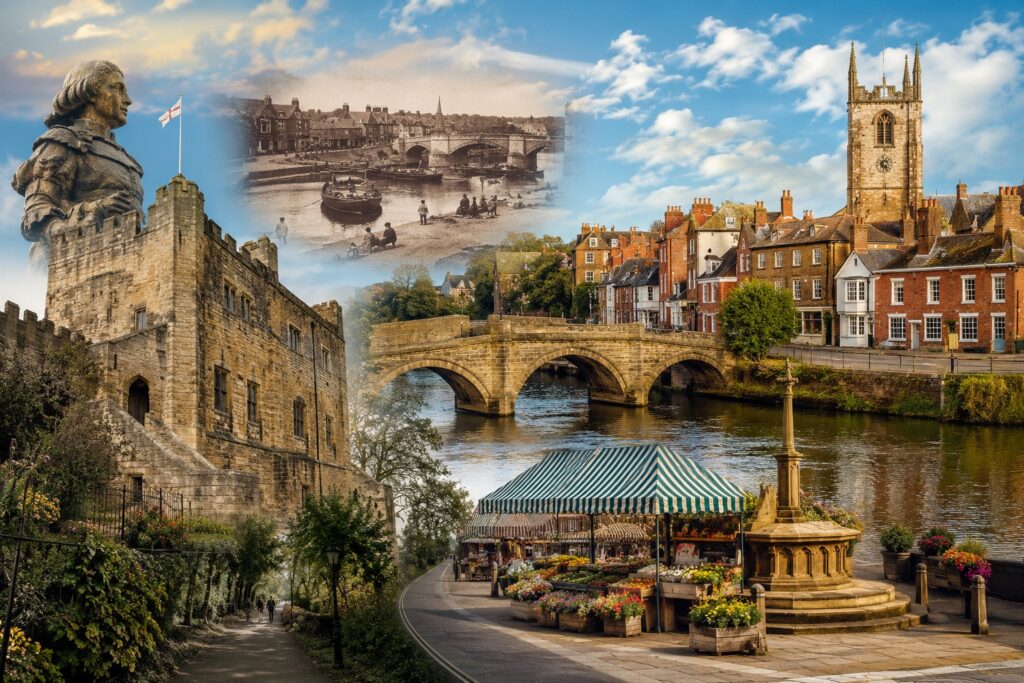
A settlement built around river trade
Long before railways and modern roads, rivers were the main arteries of commerce. Yarm’s position beside the River Tees gave it a natural advantage. Goods could be moved in and out with relative ease compared to inland settlements, and this helped the town grow into an important local trading point.
Early Yarm was closely tied to agriculture. Farmers from surrounding villages would bring produce to sell or exchange. Over time, these informal gatherings became more structured, eventually forming a recognised market system. That market tradition would go on to define the town’s identity for centuries.
Even now, when you walk through Yarm, the layout quietly reflects its past. The wide, elongated high street is not accidental. It was designed to accommodate market stalls, livestock movement, and large gatherings of traders.
The high street that feels like a preserved timeline
One of the most memorable parts of Yarm is its high street. Unlike modern shopping districts that are built for speed and convenience, Yarm’s main street feels deliberately stretched and open.
The buildings along it tell a long architectural story. Georgian elegance sits next to Victorian practicality, and in some places, even earlier structures still remain. Many of these buildings were once used for completely different purposes. Inns served travellers, warehouses stored goods, and merchant homes doubled as business spaces.
What makes the street particularly interesting is not just its appearance, but its continuity. Despite centuries of change, it still functions as a central hub for local life, proving that historical design can still serve modern needs.
Railways that changed everything
The arrival of rail transport in the 19th century reshaped much of northern England, and Yarm was no exception. The town became connected to wider industrial networks, allowing faster movement of goods and people than ever before.
A key landmark from this era is the impressive railway viaduct that crosses the surrounding landscape. Built from brick and stone, it stands as a reminder of the engineering ambition of the time. When it was constructed, it represented progress, linking Yarm more directly to growing industrial centres.
This shift from river-based trade to rail-based transport marked a turning point. While the river had once defined the town’s economy, the railway expanded its reach far beyond local boundaries.
Market traditions that shaped everyday life
Yarm’s identity as a market town is not symbolic—it is deeply rooted in its history. For centuries, it functioned as a place where rural communities came together to trade goods, share news, and maintain social connections.
Livestock markets were especially important in earlier periods. Cattle, sheep, and other animals were brought in from nearby farmland, creating busy trading days that shaped the rhythm of local life.
Markets were not just economic events. They were social occasions that brought together people from different villages, reinforcing Yarm’s role as a regional meeting point.
Even as modern shopping habits have changed, traces of that market culture still remain in how the town feels and operates.
A town shaped by architecture and adaptation
One of the most striking things about Yarm is how well its historic buildings have survived. Many English towns have lost their older structures to redevelopment, but Yarm has managed to retain much of its original character.
The architectural mix tells a story of gradual change rather than sudden transformation. Brick terraces, stone details, and traditional shopfronts sit together in a way that feels organic rather than staged.
This blend of styles reflects how the town has grown. Instead of replacing its past, it has layered new developments onto it, creating a visible timeline of different eras.
The River Tees as a constant presence
The River Tees has always been more than just scenery for Yarm. It has influenced settlement patterns, trade routes, and even risk management in the form of flooding over the years.
In earlier centuries, the river was essential for transport and commerce. Today, while it no longer plays that economic role, it remains central to the town’s character. Walking paths along the river offer quiet views and a sense of openness that contrasts with the structured high street.
The relationship between Yarm and the river is a reminder of how geography continues to shape human settlement, even when technology changes how we live.
Everyday life in a historic setting
Despite its long history, Yarm is not a museum town. It is a living, working community where people shop, commute, and socialise as they would anywhere else.
Independent shops remain a strong feature of the high street, giving it a personal feel that larger commercial centres often lack. Cafés, small businesses, and local services contribute to a steady rhythm of daily activity.
What stands out is how naturally the past and present coexist. History is visible, but it does not dominate. Instead, it forms a backdrop to modern life.
Lesser-known details that add character
Beyond the well-known landmarks, Yarm also has smaller details that reveal more about its personality.
Some of the older buildings along the high street still contain features from their original construction, including beams, stonework, and structural designs that have survived centuries of use.
There are also subtle clues in the town layout that hint at its medieval origins. The spacing of buildings and the shape of the street are not random—they reflect planning decisions made long before modern urban design existed.
These details are easy to miss at first, but they add depth to the experience of walking through the town.
Why Yarm continues to stand out
Yarm’s appeal lies in its balance. It is historic without feeling frozen, and modern without losing its identity. Many towns struggle to maintain that equilibrium, but Yarm manages it through continuity rather than reinvention.
Its history is not confined to plaques or museums. It is built into the streets, the river, and the architecture. That is what makes it feel authentic rather than recreated.
For visitors exploring North Yorkshire, Yarm offers something subtle but memorable: a place where centuries of change are still visible in everyday life.
Final reflection
Yarm has never been a place defined by dramatic events or grand narratives. Instead, its story is one of steady growth, trade, and adaptation. From its early market beginnings to its railway connections and modern community life, it has evolved while keeping its core identity intact.
That quiet continuity is what gives Yarm its character. It is not just a town you pass through—it is a town that quietly reveals its history the longer you stay.
The written content on this page was generated by ChatGPT.