The Cultural and Historical Significance of Yarm on the River Tees
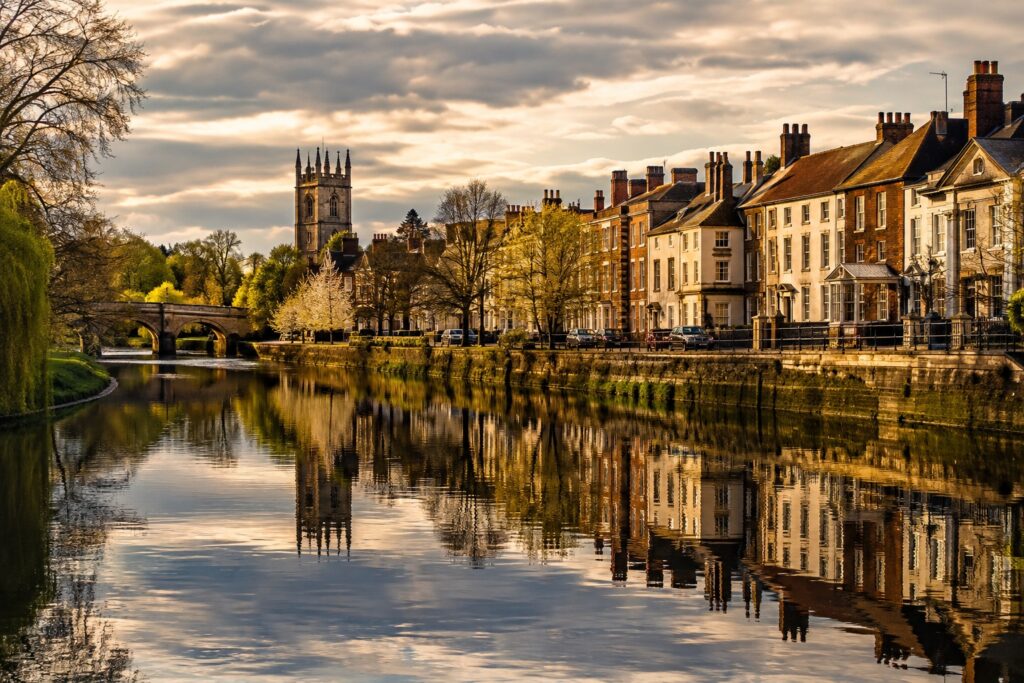
Yarm, North Yorkshire, is the kind of town where the landscape tells much of the story. Its attractive High Street, historic bridge, railway viaduct and position beside the River Tees are not simply picturesque features. Together, they reveal why Yarm became an important centre for trade, travel, transport and community life over many centuries.
Today, Yarm is widely appreciated for its historic character, independent shops, restaurants and riverside setting. Yet beneath its modern appeal is a much older story. The River Tees shaped where the town developed, how people travelled, what goods passed through it and why Yarm became an important stopping point between major settlements in northern England.
Understanding the history of Yarm on the River Tees therefore means looking beyond individual buildings. It means considering the relationship between the river, the roads, the market, the bridge and the people who made the town their home.
Yarm’s Location Helped Shape Its History
Yarm occupies a distinctive position on a meander of the River Tees. The historic town developed around an important crossing point where the river could be crossed relatively conveniently. Its location gave Yarm an advantage that would remain important for hundreds of years.
The town’s name is thought to have Old English or Old Norse origins associated with an enclosure for catching fish, an indication of how closely the settlement’s early identity may have been connected with the river. Yarm is recorded in the Domesday Book of 1086, although its history extends further back than that record.
The river was more than a geographical feature. It was a source of food, a route for commerce and a natural obstacle that had to be crossed. That combination helped make Yarm strategically useful.
Its position also placed it on routes connecting communities to the north and south. Before modern roads and railways transformed transportation, a reliable river crossing could make an enormous difference to the growth of a settlement.
Yarm as a Medieval Market and Trading Town
One of the most important developments in Yarm’s history came during the medieval period. In 1207, King John granted Yarm a charter allowing it to hold a weekly market. The charter helped establish the town’s long-standing commercial identity.
Markets were central to medieval life. Farmers, merchants, craftspeople and travellers depended on them to exchange goods and services. Yarm’s position beside the Tees and at an important crossing made it particularly well suited to this role.
The town also developed a reputation as a trading centre. Historical accounts describe Yarm as an important medieval port, with the river navigable to the town. Industries associated with the settlement included rope making, brewing, tanning and shipbuilding.
This period helps explain why Yarm developed a relatively substantial town centre rather than remaining a small riverside settlement.
The River Tees connected Yarm to a wider commercial network, while the roads brought travellers through the town. For centuries, these two forms of movement worked together.
The Historic Yarm Bridge
Few structures demonstrate the relationship between Yarm and the River Tees more clearly than Yarm Bridge.
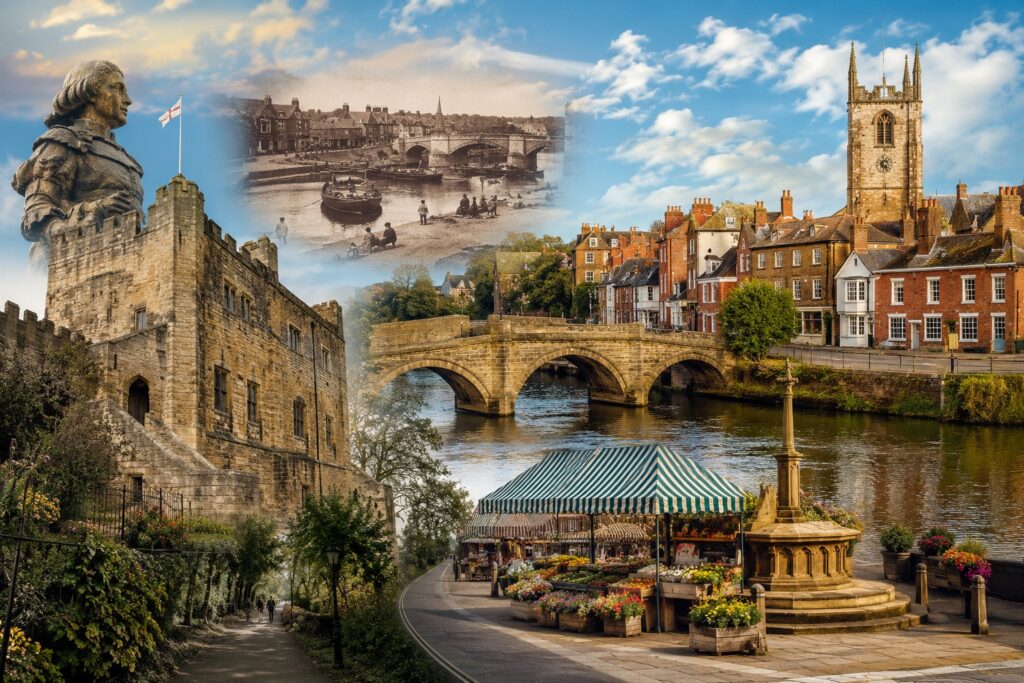
The bridge that stands today has medieval origins. It was commissioned around 1400 by Walter Skirlaw, Bishop of Durham, replacing an earlier bridge believed to have been built around 1200. Historic England lists Yarm Bridge as a Grade II* structure because of its special architectural and historic interest.
The bridge was not merely a convenient way to cross the river. It was an essential part of Yarm’s economic life.
For travellers, merchants and local residents, the crossing connected communities on either side of the Tees. The bridge also had defensive significance at certain points in its history. Stockton Heritage records that its northernmost arch once incorporated a drawbridge, which was used during the English Civil War as part of efforts to control movement across the river.
The bridge itself has also experienced dramatic changes.
An iron replacement was constructed in 1805, partly because concerns had been raised about the effect of the existing bridge on river flow and flooding. The experiment was short-lived: the iron structure became unusable after an arch collapsed in 1806. The older stone bridge was subsequently returned to service after alterations.
The survival of the medieval stone bridge gives modern visitors a tangible connection to Yarm’s past.
Yarm as a River Port
It can be easy to think of Yarm primarily as a market town today, but its history as a port is an important part of its identity.
For a period, Yarm was the highest navigable point on the River Tees and became an important location for moving goods. The river provided a means of transporting commodities before the development of modern highways and railways made overland transportation faster and more practical.
Yarm’s commercial importance was linked closely to its geography. Goods could arrive by river and continue into the surrounding region, while agricultural products and other commodities could move in the opposite direction.
By the 19th century, however, the commercial balance was changing. The growth of Stockton and later Middlesbrough altered the economic geography of the Tees Valley. Historical descriptions from the Victorian period show that Yarm still possessed warehouses and granaries associated with its earlier trading activity, even though the town’s prominence as a commercial port had declined.
This transition is an important part of Yarm’s story. The town did not simply disappear when river commerce declined. Instead, its identity gradually shifted toward road travel, services, residential life and eventually railway connections.
The High Street and Yarm’s Coaching Heritage
The wide High Street is one of the most recognizable features of Yarm.
Its appearance reflects the town’s historic importance as a stopping place for travellers. Before the age of motorways and modern transport, long-distance journeys were slower and required regular places to stop, eat, rest and change horses.
Yarm benefited from its position on important routes between northern towns and cities. The town developed numerous inns and coaching establishments, creating a lively commercial environment around the High Street.
The connection between transportation and architecture is still visible today. Historic buildings, former inns and traditional façades help preserve the atmosphere of the town’s coaching era.
A 19th-century description of Yarm noted its long, spacious main street, inns, market place, town hall, warehouses and other commercial buildings.
Walking through Yarm today can therefore feel like moving through several different periods at once. Medieval trade, Georgian architecture, Victorian transport and modern retail all occupy the same compact area.
Yarm and the Birth of the Railway Age
Perhaps the most remarkable chapter in Yarm’s transportation history is its connection with the development of Britain’s railways.
The George and Dragon Inn in Yarm has a particularly interesting place in this story. According to Yarm Town Council, a meeting held there on 12 February 1821 helped press forward the successful attempt to obtain parliamentary approval for the Stockton and Darlington Railway.
The Stockton and Darlington Railway opened in 1825 and became one of the defining milestones in railway history.
This connection is significant because it demonstrates that Yarm was not merely affected by the Industrial Revolution from a distance. People connected with the town were involved in discussions surrounding one of the developments that would transform transportation in Britain.
Railways would eventually change the role of the River Tees. Where rivers had once provided essential transportation routes, railways could carry goods and passengers more quickly and efficiently over land.
Yarm adapted once again.
The Yarm Viaduct Transformed the Landscape
The arrival of the railway left an enormous physical mark on the town.
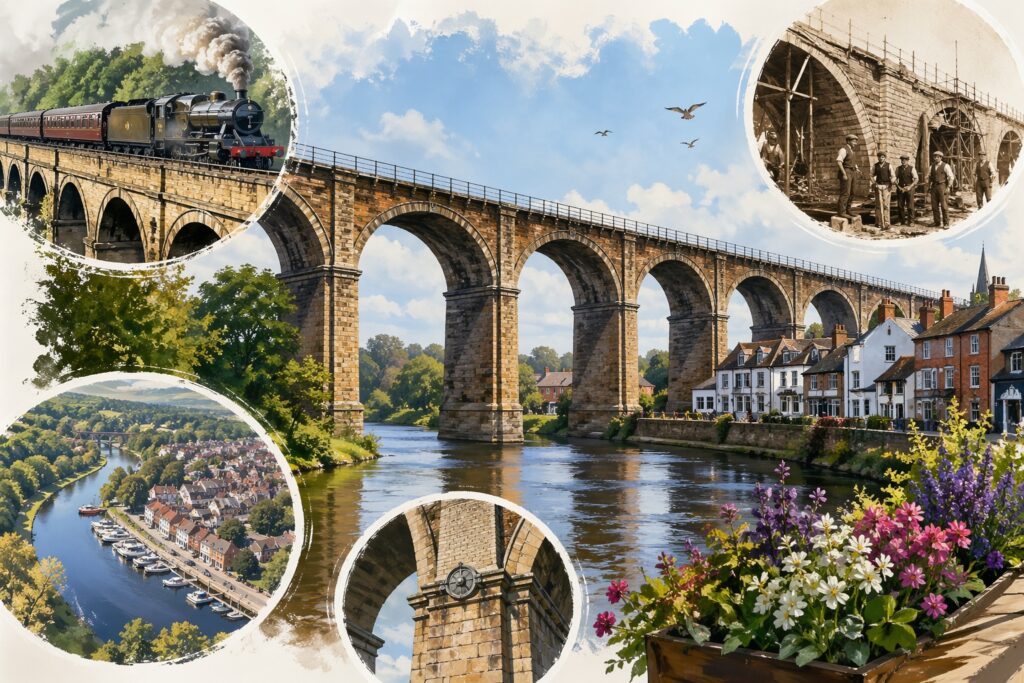
The Yarm Viaduct, constructed for the Leeds Northern Railway between 1849 and 1851, stretches for more than half a mile and crosses both the town and the River Tees. It contains 43 arches and was built using millions of bricks.
The scale of the viaduct is striking. It towers above the historic town and creates one of the most distinctive views in Yarm.
Its construction also represents a fascinating moment in local history. The medieval bridge represents an era when river crossings and horse-drawn transport dominated travel. The viaduct represents the industrial age, when railways were beginning to reshape Britain’s economy.
Both structures remain visible today, creating an unusual architectural conversation between medieval and Victorian engineering.
The River Tees runs beneath them, essentially linking these different chapters of Yarm’s history.
Yarm Fair: A Tradition That Has Survived for Centuries
Yarm’s cultural identity is also preserved through traditions rather than buildings.
Yarm Fair traces its origins to the royal charter of 1207. What began as a commercial event associated with livestock and trading has evolved into the modern annual fair held on the High Street.
The transformation from medieval trading fair to modern funfair illustrates how local traditions can survive even when their original purpose changes.
Some ceremonial customs connected with the event continue to reinforce the link between present-day Yarm and its medieval past. The Riding of the Fair and other traditions help turn history into something that residents and visitors can experience rather than simply read about.
This is one of the most interesting aspects of Yarm’s cultural heritage. History here is not confined to museums or archives. It appears in annual events, familiar streets and community traditions.
Religious Heritage and the Friars of Yarm
Religion also played an important role in medieval Yarm.
Dominican friars, sometimes known as Black Friars or Friar Preachers, settled in Yarm around 1286. Their religious community included a friary and hospital that continued until the 16th century. The influence of this period survives in local place names, including Friarage and Spital Bank.
These remnants show how medieval religious institutions could influence the physical geography of a town.
Although the friars themselves are long gone, their presence remains embedded in Yarm’s landscape. Place names can be surprisingly powerful historical records because they preserve connections that might otherwise disappear from everyday memory.
Architecture as a Record of Yarm’s Past
Yarm’s historic architecture is another reason the town has retained such a strong sense of identity.
The historic central area was designated as a conservation area in 1972. A heritage assessment describes the old town as occupying a peninsula created by a bend in the River Tees, with the river helping to define the historic settlement.
The High Street contains buildings representing different stages of Yarm’s development, particularly Georgian and later Victorian influences.
The architecture reflects the wealth that once flowed through the town. Merchants, travellers and professionals created demand for substantial houses, inns, shops and commercial premises.
Rather than being arranged around a grand monument, Yarm’s heritage is distributed throughout the town. The street itself becomes the historical attraction.
The River Tees and Yarm’s Changing Identity
The most important theme running through Yarm’s history is change.
The River Tees first helped make the settlement useful as a crossing and source of resources. It then supported trade and navigation. Later, the bridge became increasingly important for road traffic, while railways eventually created an entirely new transportation network above the river.
The river remained constant while the ways people used it changed.
This is particularly noticeable when looking at the decline of Yarm’s importance as a port. As Stockton and Middlesbrough expanded during the industrial era, the economic centre of gravity along the Tees shifted. Yarm increasingly became known for its historic character and its role as a road and railway settlement rather than as a major commercial port.
That transition is part of what makes the town interesting today. Yarm’s identity was not created during one particular period. It accumulated layer after layer.
Why Yarm’s History Still Matters Today
The cultural and historical significance of Yarm lies in the way its different eras remain visible together.
A visitor can stand on the historic bridge and look toward the railway viaduct. Nearby, the High Street preserves buildings associated with centuries of commerce and travel. Annual traditions recall a medieval market charter, while the surrounding riverside landscape reflects the geography that helped establish the settlement in the first place.
Few places tell their history so clearly through their physical surroundings.
Yarm also illustrates a broader story about northern England. Its development reflects the changing importance of rivers, markets, roads, coaching routes, railways and modern tourism. The town’s history is therefore local, but it is also part of the much larger story of transportation and economic change in Yorkshire and the Tees Valley.
Exploring Historic Yarm Today
For anyone interested in Yarm, North Yorkshire history, the best approach is to explore the town on foot.
Begin around the High Street, where the historic buildings provide an immediate sense of Yarm’s past. Continue toward Yarm Bridge and take time to appreciate its position over the River Tees. From there, look for views of the railway viaduct, one of the town’s most recognizable landmarks.
Walking along the riverside can provide a different perspective. The Teesdale Way passes near Yarm and offers views of the river and surrounding landscape.
The experience is more than a sightseeing trip. Each part of the town helps explain why Yarm developed where it did.
A Town Shaped by Water, Trade and Travel
Yarm’s cultural and historical significance comes from its unusual combination of geography and continuity.
The River Tees gave the town a reason to exist and helped determine its position. The bridge made the crossing practical. The market brought people and commerce together. The port connected Yarm to wider trading networks. Coaching routes brought travellers through the High Street. The railway transformed the surrounding landscape and connected the town to Britain’s industrial expansion.
Through all these changes, Yarm retained its identity.
Today, the town may be better known for its attractive High Street, restaurants, independent businesses and picturesque riverside setting than for its former role as a port. Yet those modern attractions make more sense when viewed against the centuries of history beneath them.
Yarm is not simply a pretty town beside the River Tees. It is a place where medieval commerce, river transport, religious history, coaching culture and Victorian engineering can still be read in the landscape.
That is what makes exploring Yarm, North Yorkshire so rewarding: the past has not been separated from everyday life. It is still part of the town itself.
The written content on this page was generated by ChatGPT.
A Walk Through Yarm England’s Georgian High Street and Historic Core
There are towns that you pass through quickly, and then there are places like Yarm, where you naturally slow down without meaning to. Something about the layout of the streets, the proportions of the buildings, and the quiet confidence of its history encourages you to take your time. Yarm in North Yorkshire is one of those rare places where the past is not staged or recreated. It simply exists in plain sight, woven into daily life.
The Georgian High Street is the clearest expression of that character. Long, wide, and lined with elegant brick buildings, it stretches through the town like a reminder of how important Yarm once was as a trading centre along the River Tees. Yet despite its historical weight, the street never feels like a museum. It feels lived in.
Arriving in Yarm and the First Impression of Space
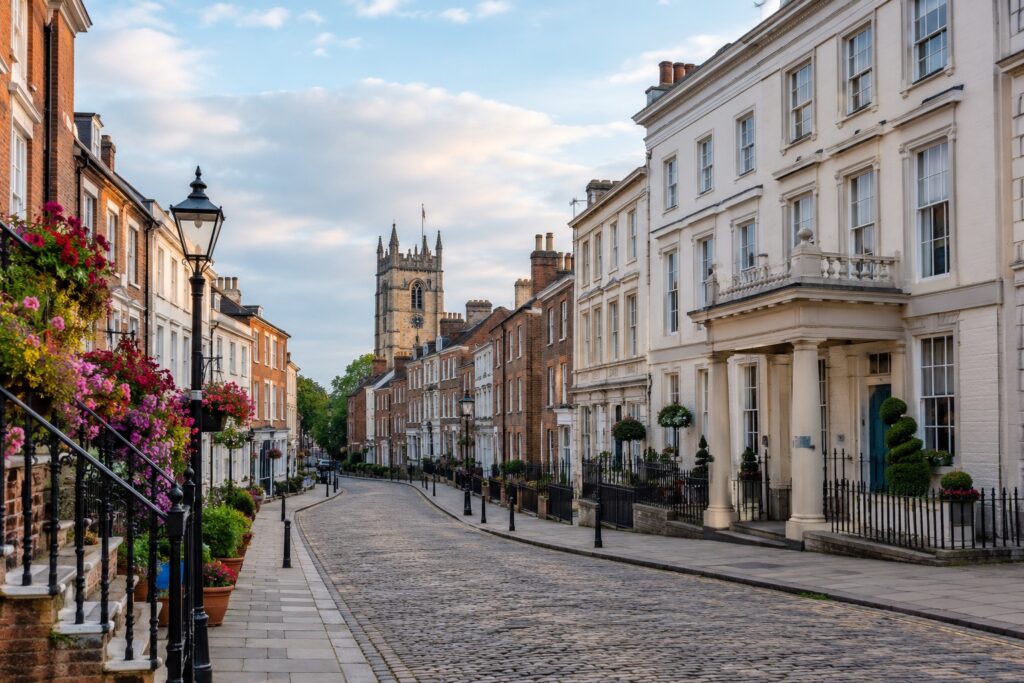
One of the first things people notice when they arrive in Yarm is the width of the High Street. It is unusually broad for an English market town, and that alone hints at its past purpose. This space was not designed for modern traffic or aesthetics. It was created for markets, livestock, and the steady movement of traders who once filled the town with noise and activity.
Standing at one end of the street, you can see how it gently curves, rather than running in a rigid straight line. That subtle bend gives the town a softness, as if it grew naturally rather than being imposed by planners. It also means that views shift constantly as you walk, revealing new angles of architecture and detail with every few steps.
Georgian Architecture That Still Shapes the Town
The Georgian period left a strong visual identity in Yarm, and it remains the dominant architectural influence today. Rows of red brick and pale stone buildings line both sides of the High Street, many of them dating back to the 18th and early 19th centuries. Their uniform height and carefully balanced windows create a sense of order that is immediately recognisable.
What makes the architecture particularly interesting is not just its preservation, but its continuity of use. Many of these buildings still serve their original purpose in a modern form. Where there were once merchant houses or storage spaces, there are now independent shops, cafes, and offices. The structure has adapted without losing its character.
Look closely and you will notice subtle differences between buildings. Some facades are slightly more ornate, with decorative door surrounds or carved stone details, while others are simpler and more functional. These variations reflect the different phases of development during Yarm’s growth as a market town.
A Market Town Built on Trade and Movement
Yarm’s history is closely tied to commerce. Long before it became a picturesque Georgian destination, it was a working market town serving the surrounding rural area. The High Street was designed to accommodate large gatherings of people and animals, which explains its unusual scale.
Cattle markets once dominated this space, with livestock being driven directly through the centre of town. Traders would gather here on designated market days, turning the street into a lively hub of negotiation and exchange. That energy shaped the identity of Yarm for centuries and still echoes faintly in the layout today.
Even though the markets are no longer held in the same way, the commercial spirit remains. Independent businesses continue to thrive, and the High Street still functions as the town’s economic and social centre.
Walking the High Street Today
Walking through Yarm now, the experience is far more relaxed than it would have been in centuries past. Instead of livestock and traders, you find people moving between cafes, boutiques, and local shops. There is a steady rhythm to the place, never rushed, never completely still.
Cafes spill softly onto the pavement when the weather allows, and conversations drift out into the street. Small details catch the eye as you walk: painted signage, flower boxes, old brickwork softened by time, and narrow alleyways leading just off the main route.
It is easy to imagine how the street would have looked in earlier centuries, yet the modern version has its own appeal. It feels balanced between preservation and everyday use, which is part of what makes it so distinctive.
Layers of History Beneath the Surface
Although the Georgian era defines Yarm visually, the town’s history stretches further back. Its position near the River Tees made it an important crossing point long before the elegant architecture arrived. Movement and trade have always been central to its identity.
Over time, developments in transport and industry across North Yorkshire reshaped how Yarm functioned within the wider region. The arrival of rail connections in the 19th century, for example, shifted trade routes and influenced how the town developed economically. Even so, the High Street remained the core of local life.
This layering of history is what gives Yarm its depth. You are not looking at a single preserved moment in time, but at a place that has continuously adapted while retaining its original structure.
The Atmosphere of a Living Heritage Town
What stands out most about Yarm is the atmosphere rather than any single landmark. It is not a place built around major tourist attractions or dramatic monuments. Instead, its appeal lies in consistency and character.
The buildings are well maintained, but not overly polished. The streets are busy, but not overwhelming. There is a sense of scale that feels human, even though the architecture is grander than many surrounding villages.
That combination creates a setting where history feels approachable. You do not need to study it to appreciate it. You simply walk through it and notice it as you go.
Ending the Walk Through Yarm
By the time you reach the far end of the High Street, the experience feels less like a visit and more like a slow conversation with the town itself. Yarm does not rely on spectacle. Its charm comes from continuity, from the way its Georgian architecture, market heritage, and modern life all exist in the same space without conflict.
It is this quiet balance that makes Yarm memorable. Not because it demands attention, but because it rewards it. A simple walk down its High Street becomes a journey through layers of English history, still visible in brick, stone, and the everyday rhythm of a town that has never stopped evolving.
The written content on this page was generated by ChatGPT.
Yarm North Yorkshire History and Surprising Facts About the Market Town
Yarm, North Yorkshire, England is the kind of place that doesn’t try to impress you at first glance. It’s calm, tidy, and easy to walk through in a short time. But that simplicity is deceptive. The more you look at its streets, buildings, and riverbanks, the more layers you start to notice. Behind its quiet present sits a long history shaped by trade, transport, and generations of everyday life along the River Tees.
This is not just another English town with a pretty high street. Yarm has evolved over centuries, and many of its features still reflect decisions made hundreds of years ago.
A settlement built around river trade
Long before railways and modern roads, rivers were the main arteries of commerce. Yarm’s position beside the River Tees gave it a natural advantage. Goods could be moved in and out with relative ease compared to inland settlements, and this helped the town grow into an important local trading point.
Early Yarm was closely tied to agriculture. Farmers from surrounding villages would bring produce to sell or exchange. Over time, these informal gatherings became more structured, eventually forming a recognised market system. That market tradition would go on to define the town’s identity for centuries.
Even now, when you walk through Yarm, the layout quietly reflects its past. The wide, elongated high street is not accidental. It was designed to accommodate market stalls, livestock movement, and large gatherings of traders.
The high street that feels like a preserved timeline
One of the most memorable parts of Yarm is its high street. Unlike modern shopping districts that are built for speed and convenience, Yarm’s main street feels deliberately stretched and open.
The buildings along it tell a long architectural story. Georgian elegance sits next to Victorian practicality, and in some places, even earlier structures still remain. Many of these buildings were once used for completely different purposes. Inns served travellers, warehouses stored goods, and merchant homes doubled as business spaces.
What makes the street particularly interesting is not just its appearance, but its continuity. Despite centuries of change, it still functions as a central hub for local life, proving that historical design can still serve modern needs.
Railways that changed everything
The arrival of rail transport in the 19th century reshaped much of northern England, and Yarm was no exception. The town became connected to wider industrial networks, allowing faster movement of goods and people than ever before.
A key landmark from this era is the impressive railway viaduct that crosses the surrounding landscape. Built from brick and stone, it stands as a reminder of the engineering ambition of the time. When it was constructed, it represented progress, linking Yarm more directly to growing industrial centres.
This shift from river-based trade to rail-based transport marked a turning point. While the river had once defined the town’s economy, the railway expanded its reach far beyond local boundaries.
Market traditions that shaped everyday life
Yarm’s identity as a market town is not symbolic—it is deeply rooted in its history. For centuries, it functioned as a place where rural communities came together to trade goods, share news, and maintain social connections.
Livestock markets were especially important in earlier periods. Cattle, sheep, and other animals were brought in from nearby farmland, creating busy trading days that shaped the rhythm of local life.
Markets were not just economic events. They were social occasions that brought together people from different villages, reinforcing Yarm’s role as a regional meeting point.
Even as modern shopping habits have changed, traces of that market culture still remain in how the town feels and operates.
A town shaped by architecture and adaptation
One of the most striking things about Yarm is how well its historic buildings have survived. Many English towns have lost their older structures to redevelopment, but Yarm has managed to retain much of its original character.
The architectural mix tells a story of gradual change rather than sudden transformation. Brick terraces, stone details, and traditional shopfronts sit together in a way that feels organic rather than staged.
This blend of styles reflects how the town has grown. Instead of replacing its past, it has layered new developments onto it, creating a visible timeline of different eras.
The River Tees as a constant presence
The River Tees has always been more than just scenery for Yarm. It has influenced settlement patterns, trade routes, and even risk management in the form of flooding over the years.
In earlier centuries, the river was essential for transport and commerce. Today, while it no longer plays that economic role, it remains central to the town’s character. Walking paths along the river offer quiet views and a sense of openness that contrasts with the structured high street.
The relationship between Yarm and the river is a reminder of how geography continues to shape human settlement, even when technology changes how we live.
Everyday life in a historic setting
Despite its long history, Yarm is not a museum town. It is a living, working community where people shop, commute, and socialise as they would anywhere else.
Independent shops remain a strong feature of the high street, giving it a personal feel that larger commercial centres often lack. Cafés, small businesses, and local services contribute to a steady rhythm of daily activity.
What stands out is how naturally the past and present coexist. History is visible, but it does not dominate. Instead, it forms a backdrop to modern life.
Lesser-known details that add character
Beyond the well-known landmarks, Yarm also has smaller details that reveal more about its personality.
Some of the older buildings along the high street still contain features from their original construction, including beams, stonework, and structural designs that have survived centuries of use.
There are also subtle clues in the town layout that hint at its medieval origins. The spacing of buildings and the shape of the street are not random—they reflect planning decisions made long before modern urban design existed.
These details are easy to miss at first, but they add depth to the experience of walking through the town.
Why Yarm continues to stand out
Yarm’s appeal lies in its balance. It is historic without feeling frozen, and modern without losing its identity. Many towns struggle to maintain that equilibrium, but Yarm manages it through continuity rather than reinvention.
Its history is not confined to plaques or museums. It is built into the streets, the river, and the architecture. That is what makes it feel authentic rather than recreated.
For visitors exploring North Yorkshire, Yarm offers something subtle but memorable: a place where centuries of change are still visible in everyday life.
Final reflection
Yarm has never been a place defined by dramatic events or grand narratives. Instead, its story is one of steady growth, trade, and adaptation. From its early market beginnings to its railway connections and modern community life, it has evolved while keeping its core identity intact.
That quiet continuity is what gives Yarm its character. It is not just a town you pass through—it is a town that quietly reveals its history the longer you stay.
The written content on this page was generated by ChatGPT.
Fun Facts About Yarm, North Yorkshire: The Story Behind the Famous Yarm Viaduct
There are towns that you pass through without much thought, and then there are places like Yarm—the kind of town that quietly surprises you the moment you start paying attention.
At first glance, Yarm feels like a traditional English market town with a tidy High Street, stone buildings, and a slow rhythm of daily life. But look a little further, especially toward the edge of the skyline, and one structure immediately changes the scene: the Yarm Viaduct. It rises above everything else, cutting across the landscape in a way that feels both dramatic and permanent, as if it has always belonged there.
The story of this structure, the Yarm Viaduct, is really the story of how Yarm stepped into the modern world.
A Landmark That Defines the Town
It is hard to talk about Yarm without mentioning the viaduct. Locals see it every day, whether they are walking along the river or standing in the town centre. Visitors often notice it even before they realise what it is.
Stretching across the valley of the River Tees, the viaduct is made up of long rows of stone arches that seem to repeat endlessly across the landscape. It has a calm symmetry to it, but also a kind of quiet power. Even after more than a century and a half, it still feels bold.
What makes it even more interesting is that it is not a relic frozen in time. Trains still pass over it daily, just as they did when it was first opened.
Born From the Age of Railways
To understand why the viaduct exists, you have to go back to a period of huge change in Britain. The 19th century was the age of railways, when tracks were being laid across the country at an astonishing pace.
Yarm became part of that transformation through its connection to the Stockton and Darlington Railway, one of the most important early railway systems in the world.
Railways were not just about travel. They were about opportunity. Towns that once relied on river trade and local markets suddenly found themselves linked to cities, ports, and industrial centres far beyond their borders. Yarm was one of those towns that changed with the times rather than being left behind by them.
Engineering That Still Holds Up Today
One of the most impressive things about the viaduct is not just its appearance, but how it was built. Victorian engineers worked with limited machinery compared to what we have today, yet they created structures that have lasted for generations.
The viaduct’s stone arches were carefully designed to spread weight evenly across the structure. This allowed heavy steam locomotives of the time to pass safely over the valley below. There is something almost timeless about the way it was constructed—practical, but also elegant in its own way.
Even now, standing beneath it and looking up, it is easy to appreciate the scale of the work involved. It feels solid in a way that modern structures sometimes do not.
More Than Just a Railway Bridge
Over time, the viaduct has become more than a functional piece of infrastructure. It has turned into part of Yarm’s identity.
For many people living in North Yorkshire, it is one of those landmarks that quietly anchors a place in memory. You might not think about it every day, but it is always there in the background.
Photographers often capture it at different times of day, especially when the light hits the arches at an angle. From certain viewpoints, it almost looks like a painting—structured, calm, and slightly dramatic at the same time.
Everyday Life Beneath a Giant Structure
What makes Yarm unique is how normal life continues right beneath such an impressive structure. People shop, walk, cycle, and go about their routines while trains pass overhead without much disruption.
That contrast is part of the charm. You have centuries-old market town life happening beneath a Victorian engineering project that still serves modern transport needs.
It is not something that feels staged or designed for tourism. It is simply how the town functions.
A Town Shaped by Movement and Trade
Before the railway arrived, Yarm was already a market town with a long history of trade. Its position near the River Tees made it a natural point for exchange and travel.
But the arrival of the railway changed its scale. Goods moved faster, connections widened, and the town became part of a larger economic system. The viaduct was not just a bridge—it was a link between Yarm and a rapidly modernising country.
Why the Viaduct Still Matters Today
Some old structures fade into the background of modern life, but the Yarm Viaduct has not done that. It still feels relevant because it is still in use. That continuity is rare.
It connects past and present in a very direct way. Every train that crosses it is a reminder that history is not something separate from everyday life—it is still happening, just at a different speed.
Final Thoughts
Yarm may not be large, but it carries a surprising amount of history within it. The viaduct is the most visible part of that story, but it is also a symbol of something bigger: change, adaptation, and continuity.
In Yarm, the past is not locked away in museums. It is built into the landscape itself. And the Yarm Viaduct is the clearest example of that—a structure that still does its job while quietly shaping the identity of the town around it.
The written content on this page was generated by ChatGPT.